
Manna Missions Tanzania




Our Mission Page 1
MANNA MISSIONS TANZANIA PROFILE.
1: When was Manna Missions Tanzania established?
Manna Missions Tanzania founder is JESUS CHRIST (YESHUA) and the initiator Joel Yalanda with his wife Glad who were imparted their vision to so many people of Tanzania.
Write the vision, and make it plain upon tables, that he may run that readeth it. For the vision is yet for
an appointed time, but at the end it shall speak, and not lie: though it tarry, wait for it; because it will
surely come, it will not tarry." —Habakkuk 2:1-3
Manna Missions Tanzania established and became true vision 1 st January 2016.
Manna Missions Tanzania is a Kingdom minded ministry with the heart of King Jesus advancing the
Kingdom of God by showing mercy ministries to the nations.
For I was hungry, and you fed me. I was thirsty, and you gave me a drink. I was a stranger, and you
invited me into your home. I was naked,
and you gave me clothing. I was sick, and you cared for me. I was in prison, and you visited me.’
“Then these righteous ones will reply, ‘Lord, when did we ever see you hungry and feed you? Or thirsty
and give you something to drink?
Or a stranger and show you hospitality? Or naked and give you clothing? When did we ever see you sick or in prison and visit you?’
“And the King will say, ‘I tell you the truth, when you did it to one of the least of these my brothers
and sisters, you were doing it to me Math 25:35-40
2: What does the ministry do?
2.1 What programs or interventions is the ministry currently implementing and what does it hope to
offer in the future?
As Manna Missions Tanzania we carry out different projects in order to improve on the living
standards of the poor people in a few areas in Tanzania and to basically help in the the education
status and reduce on unemployment problems. These projects have been carried out but sometimes
they have been limited by the problem of finances.
Why our ministry does this for widows and orphans ? According to James 1:27, “visiting the widow
and the fatherless in their distress” is considered by God to be “pure and undefiled worship.” In fact,
the last line of this passage, which says “and to keep oneself unpolluted (or unstained) by the world,
actually does not have the word “and” in the original Greek text. When this passage is read in its
entirety without the word “and” it tells us that the care of the widow and the fatherless keeps us from
being unpolluted by the world. In other words, it is a significant measure of our faithfulness to our
bridegroom, Jesus. In essence, the implications for not caring for the widows and the fatherless, is, that
we, as the church or ministry, are living in an adulterous relationship with the world.
It should be noted that the 2 things that Jesus does for us when we accept his proposal of marriage (the
Gospel) is take away our eternal widowhood and the fatherless.
According to Jewish tradition when a woman agrees to marry a man she is considered to be his wife even before t he wedding ceremony takes place. This also means that she immediately comes under the authority of her father-in-law rather than her own father, even though she will remain in his physical house until the wedding ceremony takes place.
Therefore, James 1:27 speaks both of the literal widows and fatherless as well as those who are spiritual widows and fatherless. This is the only possible explanation for the outcome recorded in Acts6:1-7. That the outcomes through caring for the widows and the fatherless will be that of deliverance and redemption for those separated from God.
Beautiful Feet Project (For Shoes). This is the project that is meant to give out shoes to the
orphaned pupils at Oldadai nursery and Primary School-in Oldadi village where we have started
with 200 children. This has been due to the long distances the pupils walk to school on bear
foot. This is also to improve on the living standards of the children in the poor area of Oldadai.
We continue to thank All friend and family from our country and outside who have supported
this event which was accommodated more than 350 poor children.
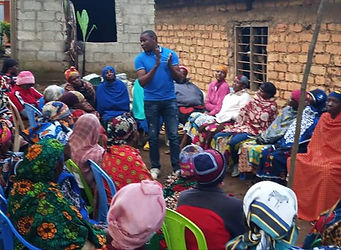
A Feeding Project: Manna Missions Tanzania feeds breakfast and lunch to over 50 widows in
the community of Sasi village every Month. Sasi village Community has a population of
7000,000 (seven thousand) people. A majority of these children are from the Maasai and Meru
tribes. The people who live in Sasi village are the poorest of the poor. Providing lunch keeps
many of the widows and their orphans children from begging on the streets.
Widows Project: This is a project meant to support widows in different areas in the country. This
is done to both HIV negative and positive people. the project is so far working in areas of SASI VILLAGE
Sweet Dreams (The Beddings Project) Support our Sweet Dreams Project. A sweet dream is a
project where we provide a mattress, bedding and a mosquito net to the orphans so that they
can have good sleep. Few of Maasai children sleep on mats or cow skins without mattresses
and blankets where Mosquitoes are many and they don’t sleep well and normally get malaria.
Good bedding and a mosquito net will make them healthy and strong. This project hasn’t taken
off well due to lack of funds for it.
2.2 Future projects and plans:- Micro-economic project for widows:
Manna Missions Tanzania is in the process of raising funds for the development of a micro
economic self-sustaining business start-up capital for the widows of Tanzania whereby they can
have a small business to earn money. We are working through a local church who ministers to
widows for this project. A portion of the profits will go to help another Tanzanian widows to
other areas to begin their business in the same manner
3
Sweet Dreams (The Bedding Project) Sweet dreams is a project where we will provide a
mattress, bedding and a mosquito net to the orphans so that they can have good sleep. We will
do this in different areas of Tanzania through the Local churches or orphanages.
A Feeding Project:- Manna Missions Tanzania will be providing food and humanitarian aid to
more than 50 widows within Sasi village and other areas of Tanzania.
Start Manna Missions Tanzania known as “Sister Florence Orphanage Center:
General information on Tanzania
The United Republic of Tanzania is a country situated in Eastern Africa. The 29 regions that Tanzania is made up of include those of the autonomous region of Zanzibar. Tourism has come to play an increasingly vital role in Tanzania’s economy. However, it is still mainly based on the agricultural sector where more than 80 per cent of the work force is employed.
Tanzania has a total population of 50 million and its capital city is Dodoma. The official and most widely
spoken language is Swahili.
Widespread poverty remains a challenge
The UN Human Development Report shows that Tanzania has made marginal steps forward in terms of human development, ranking 152nd out of 187 countries in the Human Development Index. However, Tanzania remains one of the poorest nations in the world. Over 28 per cent of the country & 39% population lives in poverty. Although the economic growth rate is one of the highest in Sub-Saharan Africa, millions of Tanzanians find themselves caught on the bottom steps of the
socioeconomic ladder.
Only a small minority has been able to benefit from the country’s recent upswing. Growth has been
neither broad based nor great enough to effectively tackle high poverty levels in Tanzania. Particularly in rural areas, poverty is a widespread and acute problem. Families who live in arid or semi-arid regions are facing unimaginable hardships in their daily lives.
35 per cent of the country’s population are chronically undernourished. For rural areas, this figure is even higher. Thousands of people live in mud huts or shacks where regular access to potable water is often nothing but wishful thinking.
Africa accounts for only one tenth of the global population but for nine out of ten new cases of HIV
infections. At 5.6 per cent, Tanzania is marked by a comparatively high HIV prevalence rate.
Approximately 1,400,000 Tanzanians are living with HIV/AIDS and 250,000 of them are children under
14 years of age. The HIV/AIDS pandemic is therefore considered one of Tanzania’s most striking health problems. It deeply hinders socioeconomic development in the country. The disease affects the food security of thousands of families, particularly in rural settings. When the head of the family falls ill, other family members – often young children – have to engage in labor activities so that they can help their family survive.
Illiteracy is more common in women than in men and remains especially persistent in rural areas where 4 school infrastructure is either poor or non-existent. Overall, nearly 30 per cent of Tanzanians do not know how to read and write in any language.
Children need support
At 38 per 1,000 live births, the infant mortality rate for Tanzania is relatively high. Most child deaths are
caused by HIV/AIDS, malaria, diarrhea, pneumonia, malnutrition and complications associated with low
birth weight. Only around half of all births are attended by skilled medical staff.
In Tanzania, an estimated 1,300,000 children are orphans due to HIV. They have lost either one or both of their parents because of the disease. Due to AIDS, the number of child-headed households in
Tanzania has increased significantly in recent years. Growing up without a family or in a dysfunctional
family environment often has serious implications on a child’s mental and physical development. Many
orphaned children experience neglect and discrimination. Children who grow up without parental care often do not attend school.
The school enrollment ratio in Tanzania has slightly improved over recent years. However, government funding of primary and secondary education is relatively low when compared to many other countries in the region. As education is often seen as the key element for the economic self-sufficiency of a child in the future, raising school enrollment and attendance figures has now become a priority of the Tanzanian government. School drop-out rates are often high due to financial constraints. Many children have to work besides school in order to increase their family’s household income.